
Exploring the Infinity: Unraveling the Mysteries of Space
Emma R.
Space is one of the few topics that can make you feel tiny and curious at the exact same time. You look up at the night sky and it feels peaceful… until you remember that what you’re seeing is just a tiny slice of something so massive we literally don’t have words for it.
And here’s the best part: we’re not just “wondering” about space anymore—we’re actively mapping it, photographing it, and discovering things that would’ve sounded like pure science fiction 20 years ago.
In this article, I’m going to walk you through the biggest mysteries people obsess over (and why they matter), the mind-bending concepts like infinity and black holes, and a bunch of practical ways you can explore space yourself—even if you’re just scrolling on your phone in bed.
What do we actually mean when we say “infinity” in space?
People throw around “infinite universe” like it’s a fact, but it’s not that simple.
In plain terms, infinity means something that has no end. But when it comes to space, scientists are usually talking about one of these ideas:
- The universe is infinite (it goes on forever)
- The universe is finite but unbounded (it loops like a sphere, so you never hit an “edge”)
- The universe is expanding (space itself is stretching over time)
NASA explains the basics of universe expansion and the observable universe in a way that’s surprisingly approachable if you want to go deeper. Source: NASA Science – Universe
The “observable universe” detail most people miss:
Even if the universe is infinite, we can only observe a limited region—because light has a speed limit, and the universe has a history.
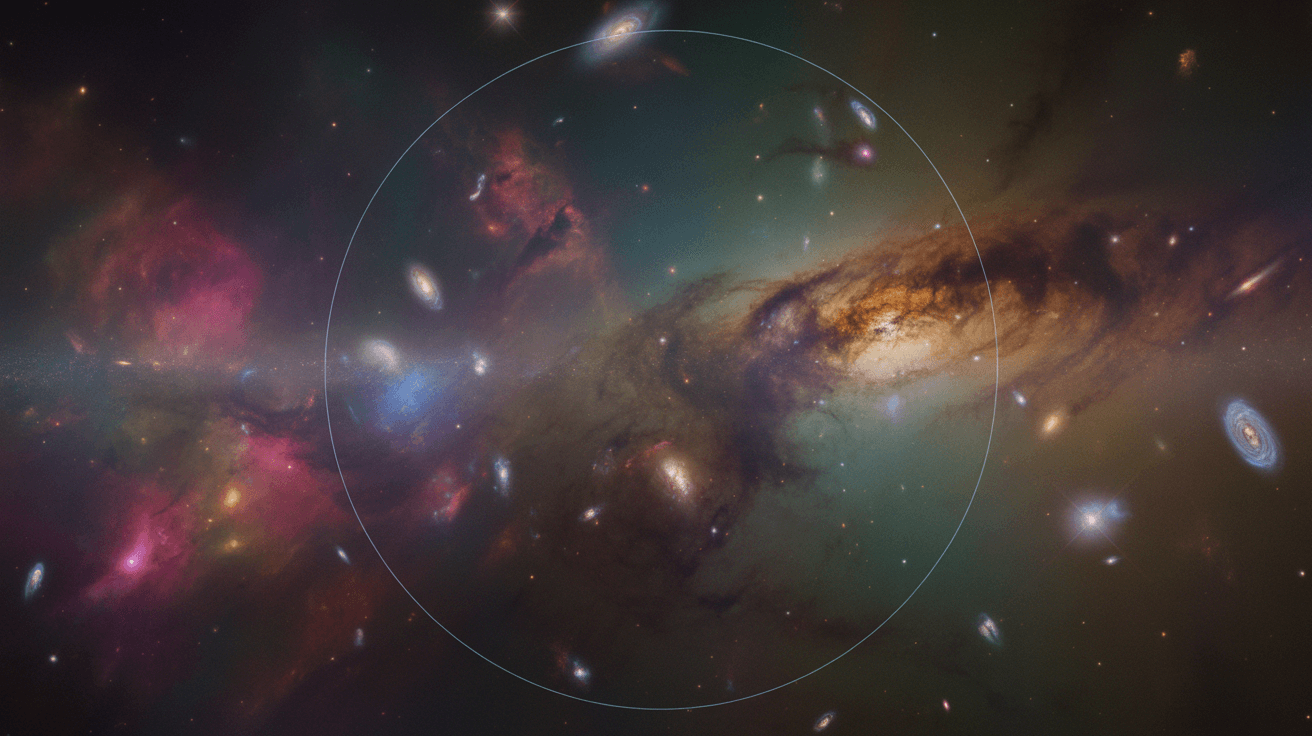
The observable universe: what we can see vs what probably exists
When you hear facts like “the universe is 13.8 billion years old,” it’s tempting to think we can see everything. But we can’t.
We’re limited by distance and time. Light from faraway galaxies takes billions of years to reach us, so we’re basically looking into the past every time we look deeper into space.
That’s why the concept of the observable universe is so important: it’s not the whole universe—it’s the part we can detect from Earth right now.
If you want a clean explainer (without turning it into a textbook), the European Space Agency breaks down what we’ve learned from observing the cosmos and why it keeps expanding our questions. Source: ESA – Space Science
Black holes: the universe’s most dramatic mystery
If space had celebrity villains, black holes would be at the top of the list. They’re the definition of “don’t get too close,” and they’re one of the best examples of how reality can be stranger than fiction.
Here’s the simplest way to understand a black hole:
- It forms when a massive star collapses
- Its gravity becomes so strong that not even light escapes
- The “edge” is called the event horizon
- Inside, the physics gets… complicated
What makes black holes so important isn’t just the drama. They’re one of the best “testing grounds” we have for understanding gravity and extreme conditions.
NASA has a very clear overview of black holes and how we study them if you want to go down the rabbit hole. Source: NASA – Black Holes
The practical “mindset shift”:
Black holes aren’t just weird objects in space. They’re like cosmic laboratories helping scientists test how the universe behaves under the most extreme conditions imaginable.
Dark matter and dark energy: the invisible majority
This one is honestly wild: everything you’ve ever touched—your phone, your house, the Earth, the Sun—is only a tiny fraction of what exists.
Scientists estimate that most of the universe is made up of:
- Dark matter (helps explain gravity and galaxy structure)
- Dark energy (linked to the universe’s accelerating expansion)
We can’t see them directly. We only know they’re there because of the effect they have on what we can observe.
If you’ve ever wanted a “big picture” explanation without the math overload, NASA’s dark energy and dark matter explainers are a great starting point. Source: NASA – Dark Energy & Dark Matter
Is there life out there? The question everyone cares about
Let’s be real: as interesting as black holes are, most people eventually circle back to the same question:
Are we alone?
The honest answer is: we don’t know. But we’re getting better at looking for clues.
Here’s what scientists focus on when searching for life beyond Earth:
- Exoplanets (planets orbiting other stars)
- Habitability zones (where liquid water could exist)
- Atmospheric signatures (gases that could hint at biology)
- Moons with subsurface oceans (like Europa and Enceladus)
Even if we don’t find alien “civilizations,” discovering microbial life would still completely rewrite how we understand biology and evolution.
Space exploration isn’t just science—it’s also culture now
One thing I find fascinating is how space has become a cultural obsession again. Not in the old “cold war space race” way—but in a very internet-native way:
- space photos go viral as wallpapers
- astronomy TikTok explains complex stuff in 30 seconds
- new telescope images trend like celebrity photos
- space missions feel like live events you can follow in real-time
Space is basically the perfect mix of beauty + mystery + “holy wow” moments, which makes it ideal for the way we consume content today.
How to explore space yourself (without expensive gear)
This is the part I love sharing, because you don’t need a telescope or a physics degree to actually enjoy astronomy.
Here are a few ways to explore space in a very real, practical way:
- Use a stargazing app to identify planets and constellations in real time
- Follow live space missions through official updates (NASA, ESA, JAXA)
- Watch launches like a sports event (with friends, snacks, and commentary)
- Pick one mystery per week (black holes, exoplanets, Jupiter’s moons) and go deep
- Save one space image as your wallpaper—seriously, it changes your mood
And if you do want to buy equipment someday, start small: a basic pair of binoculars can be more fun than an overpriced telescope you never learn how to use.
A simple “space curiosity” guide (quick table)
FAQ
Is the universe actually infinite?
We don’t know for sure. It might be infinite, or it might be finite but without an edge. What we do know is that the universe is expanding and that we can only observe a limited region of it.
What happens if something falls into a black hole?
Once it passes the event horizon, it can’t escape. From the outside, we can’t see what happens beyond that boundary. Black holes are still one of the biggest mysteries in modern physics.
Why can’t we see the whole universe?
Because light needs time to travel. Some parts of the universe are so far away that their light hasn’t reached us yet (and may never reach us, depending on expansion).
What’s the difference between dark matter and dark energy?
Dark matter is linked to gravity and helps explain galaxy structure. Dark energy is linked to the accelerating expansion of the universe. Both are invisible, and we detect them by their effects.
Can I explore space without a telescope?
Absolutely. You can use sky-mapping apps, follow NASA/ESA updates, watch live launches, and explore incredible telescope images online. Curiosity is the real entry point.
Key Takeaways
- “Infinity” in space is a concept, not a confirmed fact—scientists still debate the universe’s true shape and size.
- We live inside the observable universe, limited by how far light has traveled since cosmic history began.
- Black holes aren’t just scary—they help scientists test extreme gravity and physics.
- Most of the universe is “invisible” to us through dark matter and dark energy.
- The search for life focuses on exoplanets, habitable zones, and atmospheric clues.
- Space is now part science, part culture—telescope images and missions trend like major events.
- You can explore space today through apps, official sources, and simple curiosity-driven learning.
 Celebrity News
 Surprising Celebrity Splits That Broke Thousands of Hearts
Written by: Alex M. Celebrity News Writer (pop culture moments, film buzz, red car...
 Fashion
 Quiet Luxury vs. Logo Mania
Written by: Sophie C. Fashion & Red Carpet Editor (runway trends, celebrity style,...